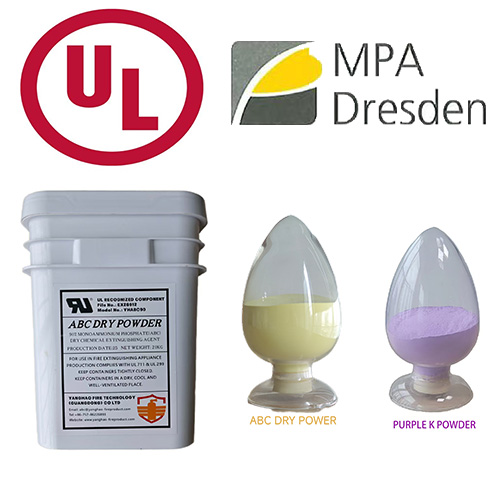
Why Flowability Is Critical for Dry Chemical Powder Performance
Introduction
When evaluating the quality of a dry chemical powder, many buyers focus on monoammonium phosphate content, certifications, or price. However, another important property often determines whether a fire extinguisher performs effectively in an emergency: flowability.
Flowability refers to how easily ABC powder moves through an extinguisher during discharge. Even a high-quality dry chemical fire extinguishing agent may fail to perform properly if the powder does not flow smoothly. Good flowability ensures that the extinguishing agent reaches the fire quickly, covers a larger area, and delivers consistent fire suppression efficiency.
Understanding this characteristic helps buyers choose better products and reduce long-term performance risks.
What Is Flowability?
Flowability describes the ability of dry chemical powder particles to move freely under pressure. During discharge, the powder must travel through the cylinder, valve, hose, and nozzle without blockage.
Several factors influence the flowability of ABC powder, including particle size distribution, surface treatment, moisture content, and the quality of monoammonium phosphate. If any of these factors are poorly controlled, the dry chemical fire extinguishing agent may discharge unevenly and lose fire suppression efficiency.
Why Flowability Matters
A fire extinguisher must respond immediately during an emergency. Poor flowability can delay powder discharge or reduce the amount of dry chemical powder reaching the flames.
High-quality ABC powder with excellent flowability provides several advantages:
Faster discharge
Stable spray patterns
Better coverage of the fire source
Higher fire suppression efficiency
These benefits improve extinguisher reliability and increase user confidence during firefighting.
Factors That Affect Flowability
Several manufacturing factors determine how well dry chemical powder flows.
Particle Size Distribution: A balanced particle size distribution helps ABC powder move smoothly while maintaining good coverage.
Surface Treatment: Hydrophobic coatings reduce friction between particles and protect monoammonium phosphate from moisture, improving the performance of the dry chemical fire extinguishing agent.
Moisture Control: Excess humidity can cause dry chemical powder to absorb water and form small agglomerates, reducing flowability and lowering fire suppression efficiency.
Raw Material Quality: High-purity monoammonium phosphate generally produces more consistent and reliable ABC powder.
Flowability and Fire Suppression Efficiency
Flowability directly affects how evenly dry chemical powder is dispersed over a fire.
When the powder flows smoothly, more monoammonium phosphate particles reach the burning surface in a short period. This improves flame knockdown, reduces the risk of reignition, and increases overall fire suppression efficiency.
If the dry chemical fire extinguishing agent discharges unevenly, some areas of the fire may receive insufficient coverage, making extinguishment slower and less effective.
How Manufacturers Improve Flowability
Professional manufacturers use several techniques to improve the flowability of ABC powder:
Selecting high-purity monoammonium phosphate
Optimizing particle size distribution
Applying advanced surface treatment
Controlling production moisture
Performing discharge performance tests
These processes help ensure that the dry chemical fire extinguishing agent maintains stable fire suppression efficiency throughout its service life.
What Buyers Should Consider
When choosing dry chemical powder, buyers should request more than chemical composition reports.
Useful technical information includes:
Flowability test results
Moisture resistance data
Particle size distribution
Storage stability reports
Discharge performance testing
These indicators provide a better understanding of how the ABC powder will perform in real fire situations.
Conclusion
Flowability is one of the most important quality indicators for dry chemical powder. It influences discharge consistency, storage stability, and overall fire suppression efficiency.
Although monoammonium phosphate is the primary active ingredient in ABC powder, the effectiveness of a dry chemical fire extinguishing agent also depends on how easily the powder flows during operation.
For manufacturers, distributors, and buyers, selecting products with excellent flowability helps ensure reliable extinguisher performance, improved safety, and long-term customer satisfaction.