Optimizing Dry Powder Efficiency
1. Introduction
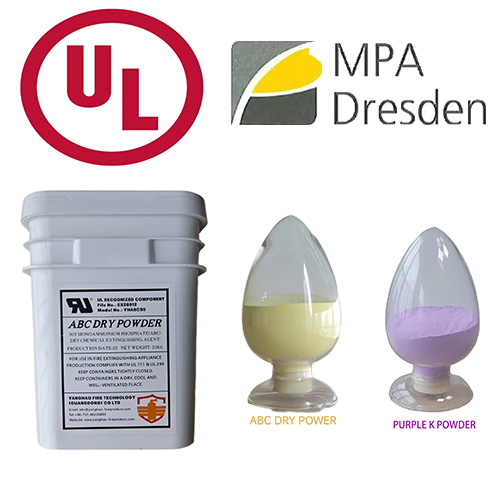
In modern fire protection systems, the performance of dry chemical powder has become a key determining factor for rapid response and effective extinguishing results. Whether used in portable extinguishers or large-scale suppression systems, the efficiency of the agent depends on both its chemical composition and its physical behavior during discharge. This article explores the connection between ABC powder, monoammonium phosphate purity, and fire suppression efficiency, with a specific focus on how powder flowability influences real-life performance.
2. Why Composition Matters
The core ingredient in ABC powder is monoammonium phosphate, a compound known for its ability to melt and form a protective layer on burning surfaces. The purity level of monoammonium phosphate directly affects flame interruption, coating formation, and heat resistance. Higher-purity formulations deliver:
faster flame knockdown
better smothering coverage
improved re-ignition prevention
Therefore, the internal chemistry of dry chemical powder plays a decisive role in overall fire suppression efficiency.
3. The Role of Powder Flowability
While chemistry is critical, the physical properties of the agent are equally important. Powder flowability describes how freely the particles move during discharge. Poor flowability can lead to:
nozzle clogging
uneven discharge rates
reduced discharge distance
ineffective flame coverage
In contrast, optimized powder flowability ensures that ABC powder disperses uniformly, creating a consistent cloud that maximizes fire suppression efficiency even in challenging fire environments.
4. Particle Size and Moisture Sensitivity
Two key factors influencing flowability are particle size distribution and moisture content. Fine particles provide good surface coverage but may clump if the powder absorbs humidity. Larger particles resist moisture but may reduce cloud density.
The ideal dry chemical powder strikes a careful balance between:
anti-caking additives
hydrophobic coating
controlled particle size
stable storage performance
This stability is especially critical for long-term use in extinguishers stored in variable temperature and humidity conditions.
5. Improving Fire Suppression Efficiency in Real Applications
To maximize fire suppression efficiency, users should follow these recommendations:
5.1 Choose high-purity monoammonium phosphate
Higher purity ensures more effective residue coating and improved flame interruption.
5.2 Ensure proper maintenance
Even the best ABC powder loses effectiveness if stored for years without inspection.
5.3 Avoid moisture exposure
Humidity can degrade powder flowability, causing lumps and uneven discharge.
5.4 Verify discharge performance
Professional laboratories can test spray patterns, flow rates, and residue behavior.
6. Industrial and Commercial Applications
High-performance dry chemical powder is widely used in:
commercial buildings
manufacturing facilities
logistics warehouses
transportation equipment
energy infrastructure
In all of these cases, purity, stability, and powder flowability contribute directly to the reliability of the suppression system.
7. Why Optimization Matters
In emergency conditions, every second counts. Poor-quality ABC powder increases extinguishing time and reduces protection effectiveness. Manufacturers, distributors, and facility owners should prioritize high-grade monoammonium phosphate and stable flowability to ensure maximum fire suppression efficiency.
8. Conclusion
The efficiency of dry chemical powder depends not only on chemical composition but also on physical behavior during discharge. By improving powder flowability, ensuring proper storage, and choosing high-purity ABC powder, users can significantly enhance fire suppression efficiency across diverse applications. In fire safety, optimized powder performance is not just a technical advantage—it is a critical factor for real-world protection.