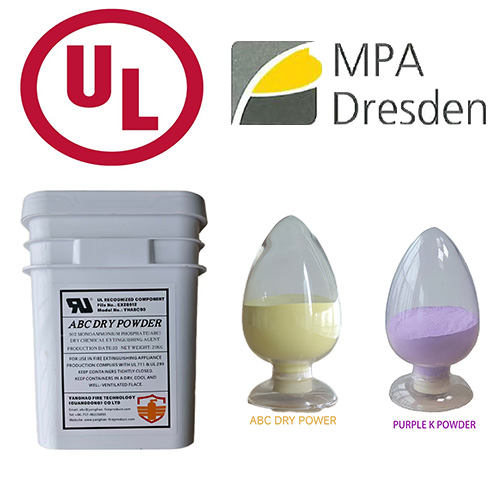
How Does Purple K Powder Stop a Fire?
When a fire starts, removing heat is not always the fastest way to control it. In many high-risk fire situations, the flame can continue to develop rapidly as long as the combustion reaction remains active.
This is where Purple K powder works differently from water-based fire suppression methods. Its primary action is chemical rather than simply cooling the burning material.
The active ingredient in Purple K is potassium bicarbonate, a dry chemical compound widely used for rapid flame suppression. When the powder reaches the flame zone, it interferes with the chemical reactions that keep combustion going.
Understanding this mechanism helps fire protection companies, equipment manufacturers, and distributors choose the right dry chemical fire extinguishing agent for their applications.
The Combustion Chain Reaction
A flame is more than a source of heat and light. Combustion involves a continuous series of chemical reactions involving fuel, oxygen, heat, and highly reactive intermediate species.
Once combustion begins, these reactions can sustain themselves. Reactive particles produced during combustion participate in further reactions, allowing the flame to continue propagating.
This process is often described as a chemical chain reaction.
Traditional fire protection methods may work by removing one of the basic elements required for combustion. For example, water can provide strong cooling, while some extinguishing methods reduce the available oxygen.
Dry chemical suppression takes another approach.
Instead of relying mainly on cooling, a suitable dry chemical can interfere with the chemical reactions occurring inside the flame. This can cause the flame to collapse very quickly.
How Potassium Bicarbonate Works
The main active component of Purple K powder is potassium bicarbonate.
When discharged into a flame, the powder particles are dispersed throughout the combustion zone. Under the conditions present in the flame, potassium-containing species are produced and participate in reactions that interfere with flame chemistry.
The result is a reduction in the reactions necessary to maintain combustion.
In simple terms:
Fire produces reactive chemical species → Purple K enters the flame → the chemical reaction is disrupted → flame propagation decreases → the flame is suppressed.
This is one reason potassium bicarbonate is associated with rapid flame knockdown.
The effectiveness of the agent, however, is not determined by the active chemical alone. Powder formulation, particle distribution, flowability, discharge characteristics, and system design can all influence how effectively the agent reaches the flame.
Why Fast Flame Suppression Matters
Fire growth can be extremely rapid, particularly when combustible liquids, gases, or other high-energy fuels are involved.
A suppression agent that takes too long to control the flame may allow the fire to spread beyond the original hazard area.
The advantage of a chemically active dry chemical fire extinguishing agent is that it can attack the combustion process directly after reaching the flame.
This makes response speed an important consideration when evaluating a Purple K product.
However, “fast suppression” should not be understood as a single property of the raw material. The actual performance of a finished system depends on several factors, including:
Active chemical concentration
Powder formulation
Particle distribution
Powder flowability
Discharge pressure
Nozzle design
Agent quantity
Fire size and fuel characteristics
System response time
A high-quality powder must therefore work reliably as part of the complete fire suppression system.
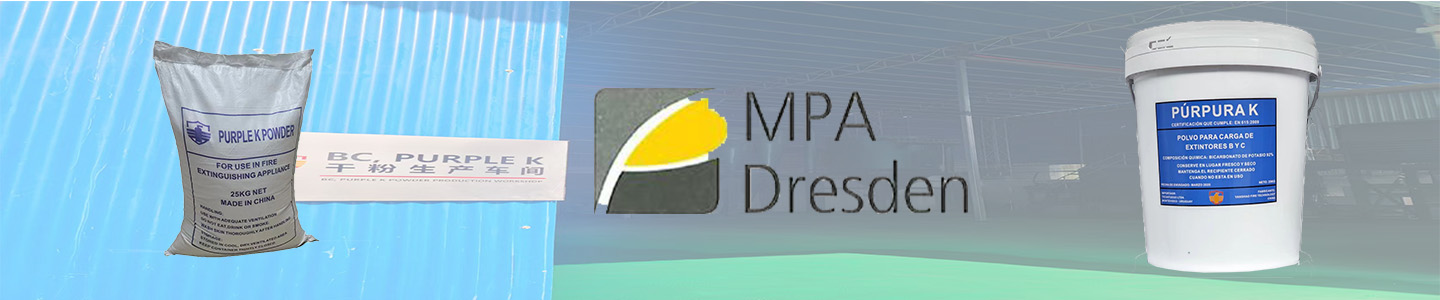
Purple K Powder Is More Than a Raw Chemical
One common misunderstanding is that purchasing potassium bicarbonate automatically means purchasing a high-performance Purple K agent.
In commercial fire protection, the finished powder is a formulated product rather than simply untreated raw potassium bicarbonate.
Manufacturers may control the physical and chemical properties of the powder to improve its discharge and dispersion characteristics. The objective is to make sure the agent can be transported, stored, discharged, and distributed effectively when needed.
For manufacturers and distributors, this distinction is important.
Two powders may contain similar active ingredients but behave differently during discharge. Differences in formulation and production control can affect flowability, dispersion, moisture resistance, and overall flame suppression performance.
This is why professional production and quality control remain important when sourcing Purple K products.
The Role of Powder Dispersion
Chemical suppression only works effectively when the extinguishing agent reaches the flame.
If the powder does not flow properly through the equipment or is not dispersed effectively, part of its potential suppression capability may be lost.
Good powder dispersion allows the agent to enter the flame zone more evenly. The particles can then interact with the combustion process across a larger area.
For this reason, manufacturers should pay attention not only to chemical composition but also to the physical characteristics of the finished powder.
Production consistency is especially important for large-volume buyers. A product that performs well in one batch but behaves differently in another can create problems for fire equipment manufacturers and end users.
Purple K and Modern Fire Protection
The development of dry chemical suppression technology has made it possible to address fire hazards where rapid flame control is especially important.
Purple K remains an important type of dry chemical agent because its chemistry is designed to interfere with the combustion process rather than depending primarily on cooling.
For fire equipment manufacturers, distributors, and industrial fire protection companies, understanding this mechanism can make product selection more practical.
The key point is simple: Purple K does not need to “cool the fire away” to begin suppressing it. Its chemical action attacks the flame reaction itself.
Of course, no extinguishing agent is suitable for every fire scenario. The correct agent must always be selected according to the fuel, hazard, equipment, applicable standards, and system design.
Choosing a Reliable Purple K Supplier
For importers and fire equipment manufacturers, the quality of the finished powder can directly affect the performance of their products.
A reliable supplier should be able to provide clear technical specifications, consistent batches, appropriate testing documentation, and professional export support.
At Yanghao Fire Technology, we focus on the production and export of dry chemical fire extinguishing agents, providing products for international fire protection markets.
For buyers looking for a stable Purple K powder supply, evaluating both chemical performance and manufacturing consistency is a better approach than comparing price alone.
Conclusion
The effectiveness of Purple K comes from its ability to interfere with the chemistry of combustion.
Its potassium bicarbonate-based formulation allows the agent to act directly within the flame zone, disrupting the reactions that sustain combustion. This chemical approach explains why Purple K is valued for rapid flame suppression in suitable fire protection applications.
For buyers, the most important lesson is that performance depends on more than the name of the chemical. Formulation, physical properties, production consistency, testing, packaging, and system compatibility all matter.
A well-formulated dry chemical fire extinguishing agent is ultimately a combination of the right chemistry and reliable manufacturing control.