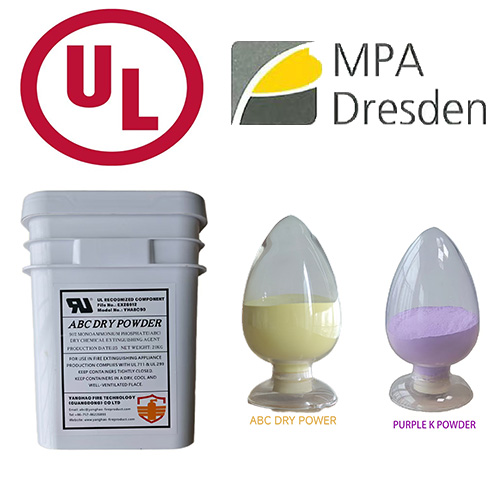
Why Anti-Caking Additives Matter
For fire extinguisher manufacturers, ABC dry powder must remain free-flowing during storage and discharge. If powder particles stick together, the material may form lumps, making handling and discharge less reliable.
Anti-caking additives and other formulation components can help improve the physical stability of a powder. Their effectiveness depends on the chemical formulation, manufacturing process, and storage conditions.
For buyers, understanding this part of the formulation helps explain why two products with similar active ingredient content may have different handling characteristics.
How Does Powder Caking Occur?
Caking happens when powder particles form aggregates that are difficult to separate. Several factors can contribute to this process, including moisture exposure, pressure during storage, particle surface properties, and changes in the powder over time.
In dry chemical powder, caking may affect flowability and make the material harder to discharge consistently.
However, caking is not always caused by one specific ingredient or manufacturing issue. A proper assessment should consider the complete formulation and the conditions under which the product has been stored.
How Anti-Caking Additives Work
Depending on the formulation, anti-caking additives may help reduce particle-to-particle adhesion or limit the effects of moisture on powder behavior.
The type and amount of additive must be selected carefully. More additive does not automatically mean better performance. An unsuitable formulation may affect other properties, including powder flow, dispersion, or compatibility with the intended application.
For a dry chemical fire extinguishing agent, the objective is to achieve a balanced formulation that supports reliable handling and meets the product's performance requirements.
Why Formulation Is More Than Active Ingredient Content
Buyers sometimes compare ABC powders mainly by their monoammonium phosphate content. While active ingredient content is important, it does not describe every characteristic of the finished product.
Formulation also affects physical properties such as particle behavior, moisture response, and flowability. Manufacturing controls are needed to ensure that these properties remain consistent between batches.
For this reason, a supplier should evaluate the finished powder as a complete product rather than relying on one specification alone.
What Should Buyers Check?
When sourcing ABC dry powder, buyers should consider the following:
Flowability: Is the powder suitable for the intended filling and discharge equipment?
Moisture control: Are moisture-related specifications clearly defined?
Product testing: Can the supplier provide relevant test data?
Storage stability: Are recommended storage conditions documented?
Consistency: Can the manufacturer maintain stable product characteristics across repeat orders?
Buyers should request technical specifications and evaluate the product against their equipment requirements and applicable standards.
Choosing a Reliable Supplier
A reliable manufacturer needs to control raw materials, formulation, processing, and finished-product quality. Anti-caking additives may contribute to powder stability, but they cannot replace proper manufacturing practices or suitable packaging.
At Yanghao Fire Technology, we focus on the production and export of dry chemical fire extinguishing agents for international markets. Buyers comparing suppliers should review the full product specification, relevant test documents, and the manufacturer's quality control process.
Conclusion
Anti-caking additives can play an important role in maintaining the handling properties of ABC dry powder. Their effectiveness depends on the overall formulation, production process, and storage conditions.
For importers and fire extinguisher manufacturers, the best approach is to evaluate flowability, moisture-related properties, product testing, and manufacturing consistency together. A well-balanced formulation can help support reliable powder handling throughout the product's intended service life.