Introduction
When buying a dry chemical extinguishing agent, customers often see both ABC and BC classifications. The two products may look similar, but they are designed for different fire hazards.
For distributors and fire extinguisher manufacturers, understanding the difference between ABC powder and BC powder is important when selecting products for different markets. The choice affects not only the type of fire that can be handled, but also the expected fire suppression efficiency.
What Is ABC Powder?
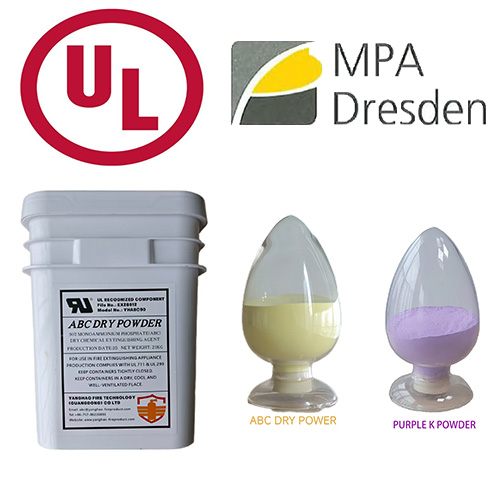
ABC powder is a multipurpose dry chemical powder designed for Class A, B, and C fires in applicable standards.
Its main active ingredient is usually monoammonium phosphate. This chemical helps interrupt the combustion reaction and can also form a protective layer over certain burning solid materials.
Because of this combination, ABC powder is widely used for general fire protection in commercial buildings, warehouses, workshops, vehicles, and other locations where several common fire hazards may exist.
What Is BC Powder?
BC powder is primarily designed for Class B and Class C fire hazards.
Unlike ABC powder, BC formulations generally do not use monoammonium phosphate as the main active ingredient. Potassium bicarbonate and sodium bicarbonate are common base chemicals used in different BC formulations.
These materials are particularly effective at rapidly interrupting flame reactions involving flammable liquids and gases.
As a result, BC products are often selected for applications where rapid flame knockdown is more important than protection against ordinary combustible materials.
The Main Difference
The simplest way to understand the difference is the range of fire hazards each product is designed to address.
ABC powder offers broader protection because it can be used against Class A hazards in addition to Class B and C applications.
BC powder focuses mainly on flammable liquid and gas fires.
This makes ABC powder a more versatile option for general-purpose fire protection, while BC products can be attractive for specific industrial hazards.

Why Monoammonium Phosphate Matters
The presence of monoammonium phosphate is one of the major differences between the two formulations.
In ABC powder, this active ingredient contributes to its performance against ordinary combustible materials. Its chemical action helps suppress flames and provides additional protection on burning surfaces.
BC formulations use different active chemicals because their primary target is rapid suppression of liquid and gas fires.
Therefore, buyers should not assume that a higher percentage of one chemical automatically means better performance. The formulation needs to match the intended application.
Which One Has Better Fire Suppression Efficiency?
There is no single answer.
For a warehouse containing cardboard, wood, packaging materials, and flammable liquids, ABC powder may provide more complete protection because of its wider application range.
For an area dominated by gasoline, diesel, solvents, or flammable gases, a suitable BC dry chemical powder may provide very rapid flame knockdown.
The best choice depends on the actual fire hazard, extinguisher design, and applicable testing standard.
Choosing the Right Product
Before purchasing ABC powder or BC powder, buyers should consider:
The main combustible materials
Required fire classes
Local certification requirements
Extinguisher size
Application environment
Required fire suppression efficiency
A general-purpose product is not necessarily the best choice for every industrial application.
What Should Importers Ask Suppliers?
When sourcing dry chemical powder, buyers should ask suppliers for more than a product name.
Useful information includes:
Chemical composition
Fire test results
Technical data sheet
Safety documentation
Applicable certifications
Recommended applications
For ABC powder, buyers should pay particular attention to the quality and consistency of monoammonium phosphate as well as the complete formulation.
Conclusion
ABC powder and BC powder are both important dry chemical fire extinguishing products, but they serve different purposes.
The key advantage of ABC powder is versatility. Its monoammonium phosphate formulation allows it to cover a wider range of common fire hazards. BC powder, meanwhile, focuses on Class B and C applications and can provide excellent performance where rapid flame suppression is required.
For buyers, the right product is not necessarily the one with the lowest price or the highest active ingredient content. The better choice is the dry chemical powder that matches the actual hazard and provides reliable fire suppression efficiency for the intended application.